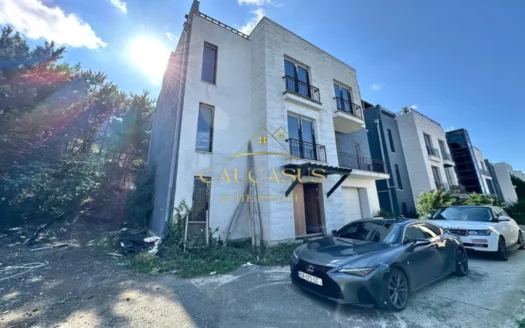
Tskneti: the district where you finish the house yourself
Tskneti sits in the forest above Tbilisi, twenty minutes by car from Vake and several hundred metres higher. It is cooler, quieter and greener than anywhere inside the city, and it is where more houses are sold unfinished than anywhere else around the capital.
That is not a defect. For a buyer who dislikes inheriting someone else’s taste in bathrooms, it is the main reason to come here.
Black frame and white frame, explained properly
Georgian property is sold at four levels of completion, and in Tskneti you will mostly be shown the first two.
| Level | What you actually get | What is left to do |
|---|---|---|
| Black frame shavi karkasi |
Structure, roof, exterior walls, windows. Bare concrete inside. | Everything: screed, plaster, wiring, plumbing, heating, kitchen, bathrooms, floors. |
| White frame tetri karkasi |
The above, plus plaster, screed and utilities brought into the house. | Interior fit-out: heating units, kitchen, bathrooms, floors, joinery. |
| Renovated | Finished and habitable. | Nothing, unless you dislike it. |
| New build | Recently completed, usually finished. | Nothing. |
The gap between black frame and finished is where the money and the months go. Before you buy at either level, get a written quote from a builder for the specific house rather than a figure per square metre, and add a contingency. Finishing a house on a hillside costs more than finishing a flat, because everything has to be carried up to it.
What it costs
Houses in Tskneti are priced per property, not per square metre: plot size, build quality, how far the construction has gone and the view all move the figure, and the range is wide. Plots come to market regularly, and several gated complexes have been built here over the past fifteen years.
Indicative only. A house in Tskneti is valued on its plot, its build and its view, and two on the same road can differ by a factor of two.
Living up here
The road down to Vake is quick outside the rush hour, and the village has its own shops and school. What people come for is the air, the silence and the forest, all of which are genuinely different from the city a few kilometres below.
Strongest point, weakest point
Strongest: the air and the temperature. In August, Tskneti is a different climate from the valley, and that is worth money to anyone who has spent a Tbilisi summer.
Weakest: winter on the upper roads. It snows, the slope is real, and from December to March you want a vehicle with proper traction. Buyers who want the green without the winter look at Lisi, lower and closer in.
Frequently asked questions about Tskneti
What does black frame actually mean?
A completed structure with walls, roof and windows, and nothing inside: no screed, no wiring, no plumbing, no heating. You budget and build the interior yourself.
Is black frame cheaper in the end?
Usually, and it is certainly more controllable. But get a builder’s written quote for that specific house before you buy, not a general price per square metre.
Is Tskneti liveable in winter?
Year-round, yes. The upper roads get snow and a vehicle with proper traction is sensible from December to March.
How far is Vake?
About twenty minutes by car outside the rush hour.
Market figures reviewed and verified by Alain Lavit, Caucasus Elite Estate, Tbilisi. Drafted with AI assistance.